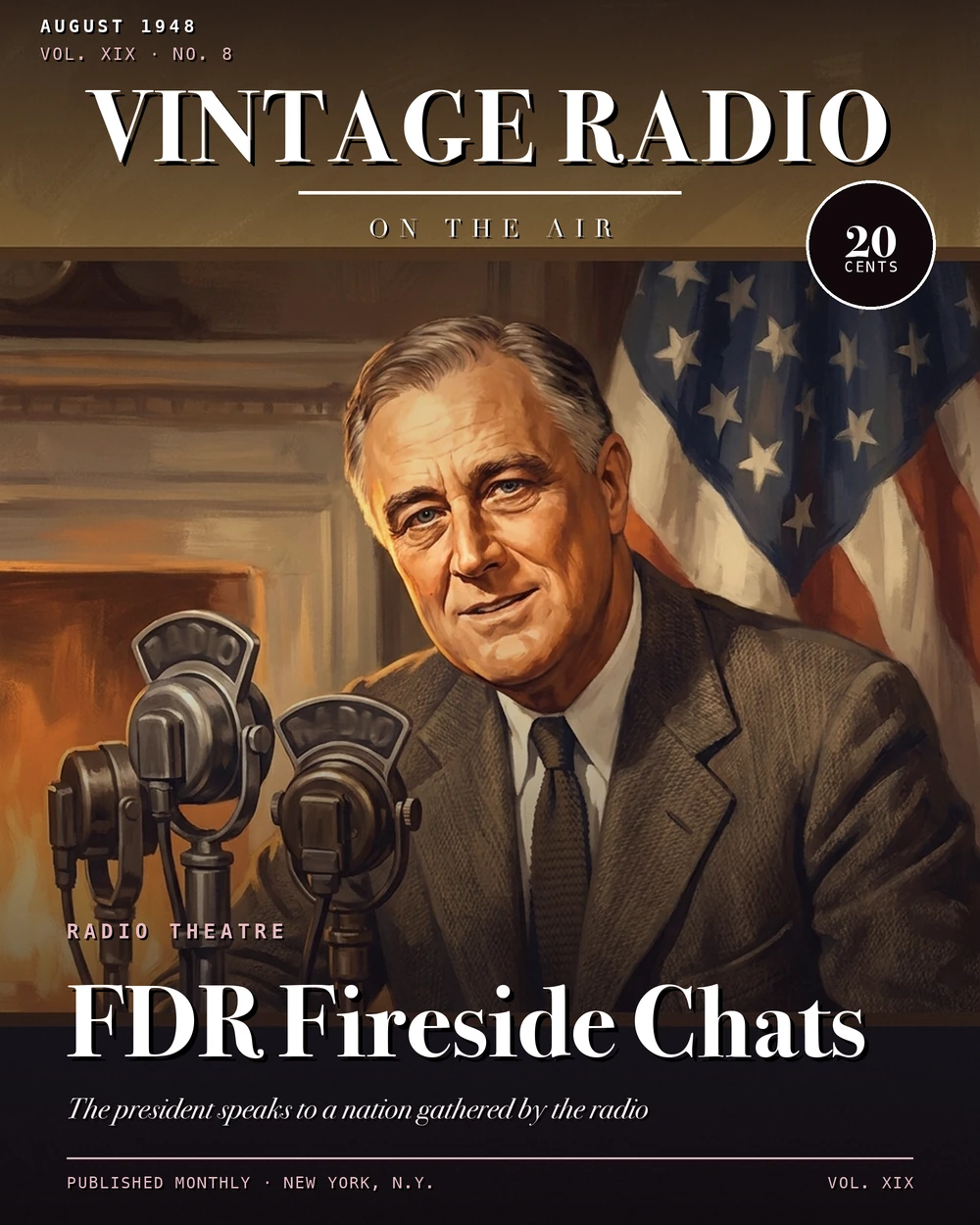
FDR Fireside Chats & Speeches
What Made These Broadcasts Different
On December 9, 1941 — two days after Pearl Harbor — an estimated 62,100,000 people sat down in front of their radios to hear Franklin Roosevelt explain what had just happened and what it meant. The Hooper rating that night was 79, the highest ever recorded for a presidential radio address, surpassing by a wide margin the 30–35 percent share that the most popular commercial radio shows of the era ever achieved. That number tells you something about what these broadcasts were: not a news program, not a speech in the conventional sense, but a direct, unmediated conversation between a president and a public that was listening as closely as it had ever listened to anything.
Roosevelt came to the format through practice. During his governorship of New York from 1929 to 1932, he occasionally addressed the state's residents directly over the radio to apply pressure on the legislature — a hint of what was coming. When he became president, his administration viewed the established press corps as editorially hostile, and radio gave him a way around it. He sat behind a desk covered in microphones from the competing networks, with a small invited audience of 20 to 30 friends and officials on folding chairs, and he talked to the country as though he were talking to the people in that room.
The phrase "Fireside Chat" itself wasn't Roosevelt's invention. CBS broadcast executive Harry C. Butcher coined it in a press release before Roosevelt's second radio address, on May 7, 1933. The inspiration came from press secretary Stephen Early's description that the president liked to think of the audience as a few people seated around his fireside. CBS journalist Robert Trout was the first to use the phrase on air, and it stuck.
The Craft Behind the Calm
The reassuring quality of these addresses was not accidental. Each speech went through roughly a dozen drafts. Roosevelt's team of political advisers — including Samuel Rosenman, Harry Hopkins, Rexford Tugwell, and Adolph Berle — worked the language carefully. For the wartime addresses, writers Robert Sherwood and Archibald MacLeish joined the process. Roosevelt also had a removable dental bridge made after discovering that a gap in his lower front teeth caused an audible whistle on the air. The production, in other words, was taken seriously from the beginning.
Roosevelt was deliberate about how often he spoke. He resisted advisers who pushed for more frequent appearances, worried that overuse would drain the addresses of their impact. During the New Deal years he broadcast approximately twice a year, announcing each chat a week or two in advance. After the United States entered World War II he increased the frequency, but only to roughly once every three months. By keeping the appearances rare, he kept people waiting for them.
All the major radio networks of the era — NBC Red, NBC Blue, CBS, and later Mutual — carried the chats simultaneously, which meant hundreds of stations across the country were broadcasting the same voice at the same moment. Most chats were scheduled in the 10 p.m. Eastern slot. Until complaints arose from clergymen, many were also delivered on Sunday evenings, when audiences were largest. During peacetime the average audience share was 18 percent. During the war it was 58 percent.
What the Broadcasts Actually Did
The first chat, on March 12, 1933 — eight days after Roosevelt's inauguration — addressed the banking crisis directly. Healthy banks reopened on March 13. Within two weeks, more than half of the funds Americans had withdrawn during the bank run had been redeposited. On March 15, the stock market recorded its largest single-day percentage gain to that point. Whether you credit Roosevelt's words or the underlying policy measures, the timing of public confidence turning around that quickly was striking enough that people noticed.
Later addresses worked differently. During the February 23, 1942 chat, in which Roosevelt outlined the principal purposes of the war, he asked citizens to have a world map in front of them as they listened. Map and atlas sales in the days before the broadcast were, by contemporary accounts, unprecedented. The chats were not just political events; they shaped behavior in immediate, measurable ways.
They were not always persuasive, however. The March 9, 1937 chat, in which Roosevelt argued for expanding the size of the Supreme Court, failed to move public opinion, and the so-called court-packing plan was defeated. The format could carry an argument as far as the argument could carry itself, but no further. A president could sound calm and trustworthy and still lose the substantive debate.
A single chat could generate more than 450,000 cards, letters, and telegrams to the White House. Mail to the Executive Mansion rose from about 800 items per day under Herbert Hoover to 8,000 per day under Roosevelt — a measure of how differently the public felt about the connection being made.
The Catalog: Chats and Beyond
How many Fireside Chats Roosevelt delivered is a question that depends on who you ask. Scholarly sources disagree, and the Library of Congress National Recording Preservation Board and Britannica both describe the number as disputed, placing it somewhere between 27 and 31. The American Presidency Project and the History Channel cite 31; other sources say "around 30." The ambiguity goes back to Roosevelt's own White House, which did not always formally designate whether a given address was an official Fireside Chat. Some speeches were clearly in the series; others were major radio addresses that occupied a gray area.
The catalog here contains 54 episodes, running from March 4, 1933 through March 1, 1945. That count reflects a broader collection than the Fireside Chat series alone — it includes inaugural addresses, State of the Union messages, wartime speeches, and other radio appearances. The March 4, 1933 entry, for instance, corresponds to inauguration day, while the first formal Fireside Chat came eight days later. Episode titles across the catalog include "On Economic Conditions," "On the Works Relief Program," "Buying War Bonds," "On National Security," "Declaration of War with Japan," "On Progress of the War," and "State of the Union," among others.
The series of Fireside Chats was among the first 50 recordings inducted into the National Recording Registry of the Library of Congress, recognized as an influential series of radio broadcasts in which Roosevelt utilized the media to present his programs and ideas directly to the public.
Why This Collection Still Matters
Roosevelt was not the first American president to use radio — but he was widely regarded as the first to use it as a direct, unfiltered channel to the public. What the Fireside Chats demonstrated was that radio could do something no previous medium had quite managed: put a leader's voice inside people's homes, in the evening, when they were quiet and paying attention, without a reporter or an editor standing between speaker and listener.
The topics shifted with the times — from banking and economic recovery in the early 1930s to war production, military strategy, and alliance-building through the 1940s — but the approach held steady. Roosevelt opened each address with a personal register, signaling that he understood what ordinary people were facing before he asked anything of them. The structure was simple. The delivery was calm. The preparation behind it was not.
These recordings are documents of the years they came from, and also documents of a decision about how to use a medium. Heard now, they carry the texture of specific moments — a bank run ending, a war beginning, a country trying to figure out what came next — delivered in a voice that was built, draft by draft, to be heard clearly through a household radio speaker.